 Illinois Fighting Illini
Season Overview
Record: 28-8
Strength of Schedule: #15 (KenPom overall)
| Type | Metric/Poll | Rank |
|---|---|---|
| Computer Rankings |
KenPom | 4th |
| T-Rank | 6th | |
| EvanMiya | 6th | |
| ESPN BPI | 6th | |
| NET Rankings | 8th | |
| Haslametrics | 4th | |
| Average | 6th |
EvanMiya Ranking & Adjustments

While Illinois ranks higher than UConn in Miya’s relative ratings, UConn has played better than their baseline against better teams, a sign of a potential advantage at the highest levels of competition (like the Final Four). The game projects to be a pretty slow pace, and UConn has also played better than typical in slower games.
Schedule & Results


Illinois is peaking at the right time. They struggled a bit with losses at the end of conference play, but a couple of those were without key players. All 8 of their losses came to tournament teams. They’ve lost 4 games in overtime this season, and all 4 occurred during that tough conference stretch (including their opening conference tournament game). Losing 3 games away from home to good teams in overtime didn’t affect their power rankings much in the slightest. On the contrary, their net rating improved with their 99 game score against VCU and 100 against Houston (in Houston) in the tournament so far.
That worst performance dot? That was the first meeting between UConn and Illinois. It was by far their worst offensive showing on the season. Their shooting from long range in that game was one of their worst efforts of the season, along with their game last round against Iowa. They’ve faced a 14 seed, 11 seed, 2 seed, and 9 seed thus far. From a resume perspective, their wins at Purdue, at Nebraska, and semi-away in the Sweet Sixteen in Houston against the Cougars have been their best wins.
Players


(Chart courtesy Hoop-Explorer.com and ESPNAnalytics)
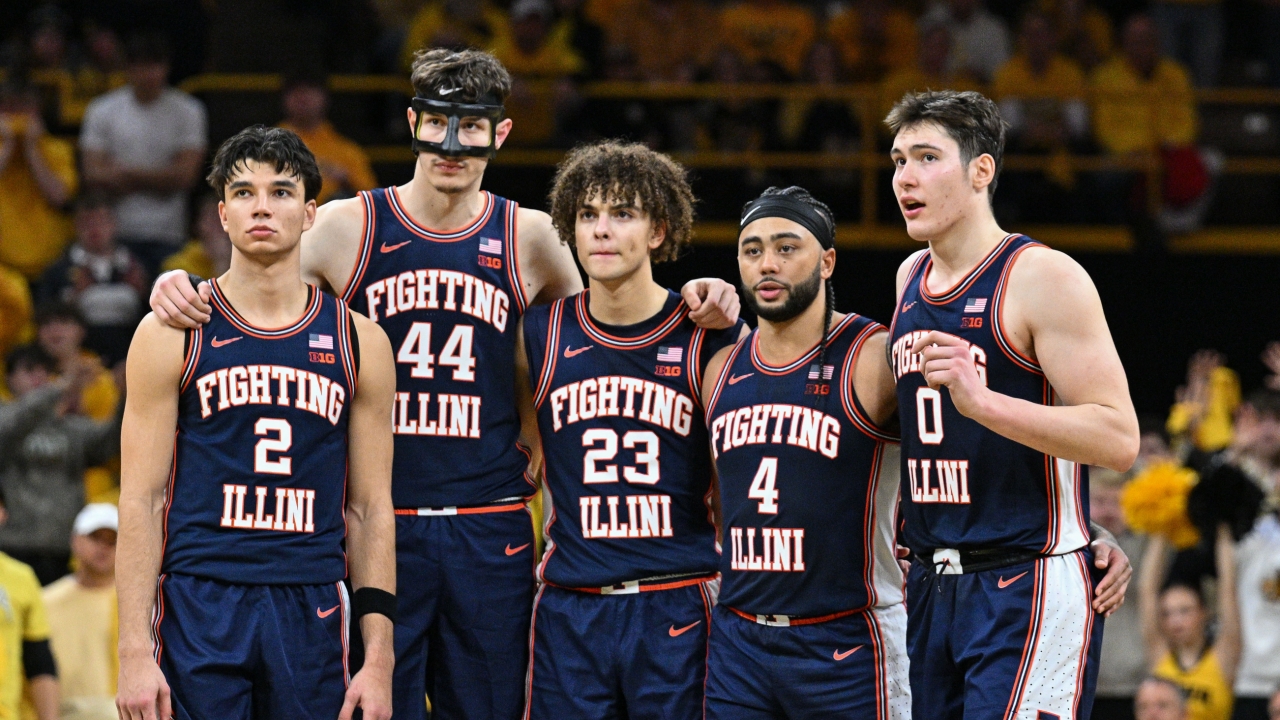
Coming into the season, the core of the Illinois team was the “Balkan Five”, an assembled group of international players directly from or with heritage from Serbia (Petrovic and Stojakovic), Croatia (Ivisic twins), and Montenegro (Mirkovic). Coach Underwood received a lot of praise for pivoting quickly into the international player pool once it became clear they would be more easily cleared in the NIL era.
However, as the season went along, Petrovic was phased out entirely, and Stojakovic was brought off the bench after an injury, though he often plays starter minutes. The keys to the offense were handed to freshman Keaton Wagler, and he’s been a stud.
Aside from the super freshmen, they have a healthy dose of veterans. They have shooters up and down the lineup (even off the bench). All 8 players in the rotation will shoot the three. They also have a ton of size on the wing and at center.
Starters
Scoring Point G - Keaton Wagler, 6’ 6” 185 - Unheralded freshman phenom who was ranked outside of the top 250 in the 247 composite. Wagler’s buzz grew during the offseason, and he was a day 1 starter for a top 20 team. Following the original UConn matchup where he had foul trouble and only played 14 minutes and scored 3 points, Illinois changed a lot of their offense’s structure. They moved Wagler from mostly off ball into a featured on-ball playmaking role, where he has truly excelled, and the team’s offense has likewise surged. He averaged 20 points and 5 assists per game in Big Ten conference play on 45/42/81% shooting splits. His assist rate was 10.5% through the UConn game, and 26.8% the rest of the season.
Keaton’s drives are at his own pace, using his size to finish without relying on explosive athleticism. His size also makes him a tenacious offensive rebounder for a guard. He's almost never sped up, and commits very few turnovers. His physicality combined with playing at his own pace is a very rare combination in a freshman, and allows him to draw a ton of fouls, in the vein of Tristen Newton. He’s also a sniper, shooting in the low 40s on both catch and shoot and off-the-dribble threes, and taking them at similar volume (6.5 combined attempts per game in conference play).
Wagler has been named First Team All Big Ten, Big Ten Freshman of the Year, and consensus Second Team All-American. He’s 5th in KenPom’s Player of the Year leaderboard, 9th in the country in BPR, 5th in BPM, and 3rd in Hoop-Explorer’s RAPM. He set an Illinois freshman scoring record and the most points by a Big Ten player against an AP top 5 team when he scored 46 points in a win on the road at Purdue.
Combo PG - Kylan Boswell, 6’ 2” 215 - Known as one of the best defensive guards in the country, the senior Kylan has been much more efficient offensively this year. He started the season taking and making more shots than the year before (scoring 25 points against UConn), however, he was supplanted as lead guard by Wagler. After fracturing his hand in practice in January, his role remained roughly the same as it was post UConn game (slight downtick in his usage in March), but his efficiency has tanked upon his return. Transitioning off ball more has allowed him to keep his turnovers down. He’s still a capable combo guard, though, who averaged 12 points and 3 assists per game in conference play.
Shooting Wing F - Jake Davis, 6’ 6” 216 - Davis is a junior in his second year on the team, and has a limited role as an offensive spacer. He entered the starting lineup upon Boswell’s injury, but has maintained his slot after his return. His minutes have ticked down in the NCAA tournament, and he plays a bench player number of minutes despite the starter designation. Per KenPom, he has the highest offensive rating in the country, in large part due to a miniscule turnover rate and shooting 41% from three. He’s only attempted 14 twos in 36 games. Despite the efficiency, he is the worst rated player in the rotation by BPR and RAPM. He doesn’t overstep his ability, an “All-star in his role”.
Combo PF - David Mirkovic, 6’ 9” 250 - Mirkovic isn’t one of the internationals coming over who is actually 22, he’s a true freshman. That being said, he was underranked by the recruiting services, who placed him outside of the top 100. He played on the Nike Hoop Summit World team alongside Eric Reibe this summer. He’s averaging 13.5 points and 8 rebounds a game, and both Net Points and RAPM consider him Illinois’ second best player. Underwood has compared Mirkovic to Alperun Sengun, and the stats show the similarities. He’s a nice post scorer, and he uses his scoring to setup his passing. He has a professional manner in his operation, calmly pivoting in the post to assess the defense, where help may be coming from, and find his cutters. He has an elite basketball IQ. He’s also surprisingly good off the dribble for his size, able to fake a DHO and then take his defender to the rim. Where he’s grown his game the most is from beyond the arc, making 38% from three on 4 attempts per game after only shooting 28% in Europe last season.
Stretch C - Tomislav Ivisic, 7’ 1” 255 - An honorable mention All-Big Ten last season, Tomi was expected to be one of the best players in the sport this season, finishing as the #25 player in my preseason composite model. He hasn’t gotten near those heights. He started the season slowly, in part due to a bone bruise suffered in practice after the team’s first game that cost him 3 games. Not much of a rim protector despite his size, he’s an elite offensive player due to his ability to stretch the court and operate as an offensive hub on the perimeter or from the post. However, similar to Boswell and Wagler, his freshman teammate Mirkovic has usurped his role a bit. His usage, shot attempts, scoring, rebounding, and assist rate are down from last season. What is up, however, is his finishing, where he’s making 74% of his twos (and 88% at the rim!), though he takes significantly more threes than twos and hits at only 31% (29% in conference play).
Bench
2 and D Wing G - Andrej Stojakovic, 6’ 7” 215 - The son of All-NBA player and NBA Champion Peja Stojakovic, Andrej played for Cal and Stanford the last 2 seasons before transferring into Illinois. His three-point stroke never translated to Champagne, but he’s finishing at 66% on close twos on healthy volume. He is smooth with his footwork, absorbing contact and still getting to his spots. He has fluid athleticism, always in control.
For the California teams, he was a relatively inefficient volume scorer, but he’s been transformed not just from the transfer to Illinois, but within this season itself. Andrej ceded some of his primary scoring offensive role during the Wagler ascension, and it compounded when he suffered a high ankle sprain in early February. When he returned, Underwood decided to continue starting Boswell and Davis, valuing the role definitions and allowing Andrej to be a scoring spark plug off the bench. He still has a healthy usage, and his minutes have ticked back up to normal starter levels in the tournament despite coming off the bench, but Illinois has been killing teams when he subs into the game, as his presence changes the flow of the game from slow and methodical to much more dynamic. He’s also showed more on the defensive side of the court this season, guarding Bennett Stirtz for much of the Elite 8 game against Iowa.
Ben Humrichous, 6’ 9” 235 - A 23-year old super senior forward who began his career at an NAIA school before starring at Evansville, he is in his second year in Champagne. A true role player who pairs defense with a classic stretch four archetype. He’s made 36% of his threes on over 4 attempts per game, and essentially never turns the ball over. He has a historically low turnover rate.
Zvonimir Ivisic, 7’ 2” 250 - The better rim protector of the two Ivisices and one of the best in the Big Ten, Big Z is 4th in the country in block rate. Like his brother, he’s a stretch center, but his shooting percentage fell off a cliff this season. He’s made only 28% of his threes so far on a little under 3 attempts per game. He is also dangerous with his height and length as a roll man in the pick and roll; Big Z has 41 dunks on the season, which contributes heavily to his insane 83% shooting on two pointers, with ¾ of his made twos coming as dunks.
Lineups

Since Stojakovic’s return from injury, the starting lineup featuring Davis has played by far the most possessions. However, both Stojakovic and Humrichous have been playing more minutes than Davis as of late. Humrichous plays the 3 and 4, while Stojakovic plays the 2 and the 3.
It’s rare for Wagler to leave the court much, he’s played three games this season with over 40 minutes. Tomi and Big Z have a 60/40 platoon at center and very, very rarely play together.
Coach and Play Summary
Brad Underwood - 13 Years, 302-136 (245-136 after NCAA sanctions), 0.69 W-L%. 9 years at Illinois, 193-109.
After working his way up the community college ranks and after multiple D1 assistant jobs, Underwood started his head coaching career at Stephen F. Austin. There he made the tournament in all 3 of his seasons, and won a game in March Madness twice, behind the star play of Thomas Walkup. He left to coach Oklahoma State, and reached the NCAA tournament in his lone season with the Cowboys. Almost exactly a year later, he left them to coach the Fighting Illini. His stint at Oklahoma State was embroiled in the FBI federal wiretapping investigation into college basketball, specifically his assistant coach Lamont Evans. After missing the tournament his first two seasons at Illinois, Underwood has made the last six dances, including a 1-seed in 2021, an Elite 8 in 2024, and this season’s breakthrough to the Final 4.
Underwood is a chameleon in the coaching world. After playing a heavy pressing scheme at Stephen F. Austin, Brad abandoned that concept at the high major level. He’s won with aggressive scoring wings like Terrence Shannon Jr., but also a dynamite pick and roll combination in Ayo Dosunmu and Kofi Cockburn. He tends now to run a 5-out offensive scheme, sometimes featuring “booty ball”. In booty ball, thick guards such as Marcus Domask back down their defender from the perimeter and then post up, taking advantage of modern spacing and their guard defenders’ unfamiliarity with defending post-up moves. The Ivisic twins’ shooting ability and Mirkovic’s low post play allows the team to invert their offense, playing the center out on the perimeter and the forward in the paint, however you can’t keep your center in the paint on either, because both shoot from three.
Illinois was playing very fast to start the season, but the switch to Wagler came with a more deliberate pace and much more half court patience. The team has slowed way down, and they played an extremely slow game against Iowa (but certainly a lot of that is due to Iowa’s pace).

Underwood generally dials up a drop coverage defensive scheme with his 7-foot bigs, with the chasers going over screens, and this is how Illinois defended UConn in the first meeting. However, they didn’t play drop coverage against Houston in the Sweet 16, and could throw curveballs at the Huskies with 5 days of prep. For example, the Illini have occasionally shown zone looks in their games this season.
Four+ Factors
| Category | Off Value | Off Rank | Def Value | Def Rank |
|---|---|---|---|---|
| Adj. Efficiency | 132.5 | 2 | 97.8 | 20 |
| eFG% | 55.1 | 36 | 47.4 | 27 |
| TO% | 13.1 | 8 | 11.8 | 365 |
| OR% | 39.4 | 3 | 26.8 | 28 |
| FTR | 33.0 | 237 | 19.4 | 1 |
(Data courtesy BartTorvik.com)
Just like when UConn took on Illinois 2 years ago in the NCAA tournament, this year’s Illinois team features an elite offense. Their defense is actually a little better than it was, in part thanks to the rim protection of Big Z, the rebounding of Mirkovic, and the point of attack defense of Boswell and Stojakovic. They’re a conservative defense, not committing fouls in exchange for not forcing very many turnovers at all and hoping their size, ability to contest shots, and winning the rebounding war tilts the scales in their favor. When I say they don’t commit fouls and don’t create turnovers, I mean they really don’t do either. They’re dead last in the country in forcing turnovers by rate, and dead first with the lowest foul rate in the country.
The offense is even better than two years ago, though. This season has seen an offensive explosion around the country, and the Fighting Illini boast the not only best adjusted offensive efficiency in KenPom this season, but in KenPom history (second in Torvik). By not turning the ball over almost ever, and killing teams on the offensive boards, they boast a huge shot volume. They achieve this in part by being the #1 tallest team by minutes-weighted average height in the country.
Shot Charts

((Shot charts courtesy Hoop-Explorer.com)
Shot selection is a big part of Illinois’ great offense. They take a ton of threes and also a ton of shots by the rim. They take a lot more of their shots in the paint than their opponents, who are frequently forced into midrange shots and floaters due to the Fighting Illini’s massive size. The drop coverage keeps opposing players in front of it, and shooting 39% on a two is a lot worse than even a moderately lower percentage shot from three. Illinois’ opponents shoot a full 5% less often at the rim than the D1 average (27.5% allowed vs. 32.6%). Their rim rate allowed has been even lower over the last 30 days (24%). Conversely, in the same time frame, the offense has increased it’s rim frequency to 41% of total shots for a net +17% rim frequency. This was +6.6% for the full season.
Style of Play

Their rim attempts on offense come from putbacks, post-ups, drives, and rolls. Relative to D1, they are extremely accurate and prolific on dribble jumpers, the majority of those taken by Wagler and Boswell.
They’re also the most frequent pick and pop team in the whole country, and in fact the most frequent pick and pop team in the entire Hoop-Exolorer database. The Ivisic brothers’ below average accuracy hurts their points per possession in this category, but there is also likely an effect of volume depressing their efficiency, and 0.96 ppp is still better than the average D1 play. Their guards frequently reject the pick and drive before passing back, which actually frees up the pop even more since there is no guard defender getting stuck to the big that needs to be extricated.
Most Frequent Offensive Plays

(Data courtesy Hoop-Explorer.com)
The most frequent play for the Illini before the UConn matchup was Stojakovic attacking the rim, but now it is Wagler doing the same. Wagler has 4 of the 6 most frequent play types on the team. His adjusted 1.26 points per possession on dribble jumpers is absurd.
Boswell also gets downhill with the ball in his hands, making things happen in the pick and roll, driving into the paint, or finding the big on a pick and pop. Between Tomi and Mirkovic, the latter is the more likely player to post up, although Tomi had a bunch of post-ups in the Iowa Elite 8 game.